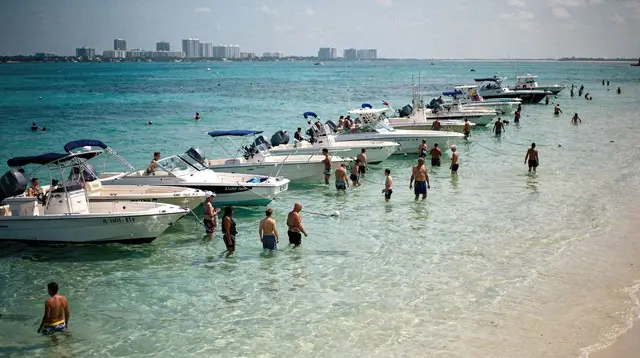
From Miami International Airport to Miami Beach
What is the best way to get from Miami International Airport to Miami Beach?
A ride-hail car or taxi is the practical option for most visitors, since Miami Beach sits on a separate barrier island reached by causeways, not by a direct rail line from the airport. Once you are in Miami Beach, free trolleys cover most local trips.
The one thing to get straight before you land
Miami Beach is not a neighbourhood of Miami. It is its own city, sitting on a barrier island across Biscayne Bay, reached from the mainland by a handful of causeways — the MacArthur, the Venetian, and the Julia Tuttle among them. Miami International Airport (MIA) sits on the mainland, west of Downtown Miami, on the wrong side of the bay from the beach. So “getting to Miami Beach” from MIA is not a short hop across town; it is a defined crossing over water, and it is worth planning for as such rather than assuming it is the same trip as getting to Downtown or Brickell.
This page covers exactly that segment: airport to beach, and getting around once you are there. It does not repeat what belongs elsewhere. The Metromover and Metrorail, which are excellent for moving around the mainland city of Miami itself, are covered on the getting around Miami guide rather than here, because neither one actually reaches Miami Beach. Tolls, parking, and the case for or against renting a car live on the car rental guide. Here, the focus stays narrow: how do you cover the MIA-to-beach stretch, and what do you do once you have landed on the island.
Why this is a distinct trip, not a city hop
A few honest facts shape every option below:
- MIA is inland, on the mainland side of Biscayne Bay. Miami Beach is across the bay, on a barrier island.
- There is no direct rail connection from MIA onto Miami Beach. Metrorail and commuter rail serve mainland destinations; the causeways are crossed by road.
- Distance on a map understates the trip. Traffic on the causeways, especially during rush hour or around events, matters more than raw mileage.
- Which part of Miami Beach you are headed to changes things. South Beach, North Beach, and Mid-Beach are reached by different causeways with different typical traffic patterns, so a ride to South Beach and a ride to North Beach are not interchangeable trips.
None of this makes the trip difficult. It just means the trip deserves its own plan rather than an assumption that it works like moving between two Downtown neighbourhoods.
Getting from MIA to Miami Beach: the real options
Ride-hail apps
For most visitors, a ride-hail car is the simplest way to cover this route. You request a car from a designated pickup area at MIA, it takes a causeway across the bay, and drops you at your hotel or rental address in Miami Beach. Fares are shown up front in the app and vary with time of day, demand, and traffic — there is no fixed number worth quoting here, so check the fare estimate before you confirm.
a private transfer service that covers Miami International and other South Florida airports is worth considering if you would rather book a fixed pickup in advance than wait in a ride-hail queue after a long flight, especially with luggage or a late arrival.
Taxis
Taxis operate from a staffed stand at MIA and take the same causeway routes as ride-hail cars. They charge metered fares rather than the pre-shown estimate you get in a ride-hail app, so ask the dispatcher or driver for a rough sense of the fare before you get in if that matters to you. Taxis are a reasonable fallback when ride-hail demand is high and wait times spike.
Shared shuttle vans
Shared vans exist and can work out cheaper per person, particularly for groups splitting the cost. The trade-off is that they typically pick up and drop off multiple parties, so the trip takes longer than a direct ride-hail or taxi. Whether that trade is worth it depends on how much you value time versus a lower fare.
Private transfer services
Booking a private transfer in advance removes the uncertainty of finding a ride on arrival, which matters most after a long flight, a late landing, or when travelling with a group and luggage. It is a fixed, pre-arranged option rather than a queue-and-hope one.
a transfer route linking Miami International Airport with Port Everglades is aimed at cruise passengers connecting onward, and the reverse route works the same way for anyone flying out after a cruise.
the return leg from Port Everglades back to Miami International Airport covers that same connection in the other direction, useful if your cruise ends before your flight home.
Helicopter transfer
For a genuinely different way to make the crossing, a helicopter transfer between Fort Lauderdale and Miami Beach turns the trip itself into an experience rather than a chore, though it is a niche choice best suited to a special occasion rather than a routine airport run.
What this page skips on purpose
If you are weighing whether to drive yourself, the tolls on South Florida’s cashless highways and the cost and scarcity of parking once you reach Miami Beach are covered fully in the car rental guide — worth reading before you decide a rental car is the right call for this leg. Short version: a car adds little value for the airport-to-beach segment alone and adds real parking cost once you are on the island.
Comparing the options
| Option | Best for | Trade-off |
|---|---|---|
| Ride-hail app | Most visitors, flexible timing | Fare varies with demand and traffic |
| Taxi | No app, or high ride-hail demand | Metered fare, ask before you ride |
| Shared shuttle van | Groups on a budget | Multiple stops add time |
| Private transfer, pre-booked | Late arrivals, luggage, groups | Booked in advance, less spontaneous |
| Helicopter transfer | A special-occasion arrival | Niche, not a routine option |
Prices are intentionally left out of this table. Check the fare shown in your ride-hail app, ask a taxi dispatcher directly, or check the current listing on GetYourGuide or Viator for a pre-booked transfer, since rates shift with fuel costs, demand, and season.
Once you land on Miami Beach
Arriving is only half the trip. Once you are on the island, Miami Beach runs a network of free trolleys that cover South Beach and other neighbourhoods with fairly frequent service, which is enough for most day-to-day movement between your hotel, the beach, and Ocean Drive or Lincoln Road. There is no need for a rental car once you are settled in Miami Beach itself; parking is limited and often paid, and the distances within the beach communities are walkable or a short trolley ride.
If your plans extend beyond the beach itself — a day trip into Downtown Miami, Wynwood, or Little Havana — that circulation is covered on the getting around Miami guide, including the free Metromover and the Metrorail line that serves the mainland.
Considering Fort Lauderdale-Hollywood instead
Fort Lauderdale-Hollywood International Airport (FLL), roughly 30 miles (48 km) north of Miami, is often the cheaper airport to fly into and can be worth considering if the airfare saving is significant. The catch is that it adds a longer road trip to reach Miami Beach, so weigh the airfare difference against the extra transfer time and any added transfer cost. For a full look at that route, see the Fort Lauderdale airport to Miami guide.
If your itinerary also involves a cruise out of PortMiami or Port Everglades, rather than only a hotel stay on the beach, the airport and cruise port transfers guide walks through that connection separately, since a cruise terminal transfer is a different trip from a hotel drop-off in Miami Beach.
Before you land: entry rules, timing, and what to pack
A few things are worth settling before you board rather than after you land, since they shape how smoothly the airport-to-beach leg goes.
Entry paperwork. Most visitors from Visa Waiver Program countries need an approved ESTA — an online travel authorisation, not a visa — applied for only through the official site, esta.cbp.dhs.gov, well before departure. Travellers who are not eligible for the Visa Waiver Program need a B-2 visa arranged in advance instead. Sort this out before you fly: it is not something a ride-hail driver or a hotel front desk can fix for you on arrival. The ESTA and entry rules for Miami guide covers exactly what to apply for and where.
When you are flying in. Miami runs on Eastern Time, shifting from UTC-5 in winter to UTC-4 during daylight saving (roughly March to November), which matters for booking a ride-hail pickup or a pre-arranged transfer at the right local hour after a long flight. The climate stays warm year-round, but the wetter, stormier stretch runs roughly May through October, while November through April is drier, sunnier, and the higher-priced high season. If your travel dates fall in the Atlantic hurricane season — officially June 1 through November 30, with the real risk concentrated August through October — it is worth reading the Miami hurricane season guide before you lock in flights, since a storm can affect both your flight and your onward transfer. For picking dates in the first place, see the best time to visit Miami.
What to bring. Pack for the climate and the practicalities of arrival: light clothing for the heat, something for sudden downpours in wet season, and a plug adapter is not needed for US visitors since Miami runs on 120V/60Hz with standard type A and B sockets, but it is worth checking for visitors from countries with different plug standards. The full packing rundown, including what to leave at home, is on what to pack for Miami.
Money matters for this leg
Prices in the United States are typically shown before sales tax, and Miami-Dade County adds a 7% sales tax on top of the fare or purchase you see quoted, so a ride-hail estimate or a transfer listing may not be the final number once tax and any airport fees are added. Tipping is also expected in the United States in a way that surprises some first-time visitors: a taxi or ride-hail driver is generally tipped, and restaurant service later in your trip typically expects 18 to 20%. The full picture of what gets taxed, what gets tipped, and roughly how much, is covered on the Miami tipping, taxes and resort fees guide — worth a quick read before your first ride from the airport rather than after.
Bring or draw US dollars; it is the only currency used, and while cards are accepted almost everywhere, a driver or dispatcher may prefer cash for a metered taxi fare.
Your first hours in Miami Beach
Once your ride drops you at your hotel, most first-time visitors want to know what is walkable and what is worth doing before they have fully recovered from travel. South Beach’s Art Deco Historic District is close to most beachfront hotels and is an easy, low-effort first outing — the Miami Art Deco district guide and the broader list of things to do in South Beach are both good starting points for a jet-lagged first afternoon or evening.
If you are still deciding how long to stay in the area before you even land, how many days in Miami and the shorter-form weekend in Miami itinerary both start from the assumption that your first and last days are partly consumed by exactly the airport transfer described on this page — worth factoring in before you build a tight schedule. For visitors planning a longer stay, three days in Miami and the general first-time visitors guide go into more detail on pacing the rest of the trip.
Finally, a handful of avoidable stumbles show up again and again with the airport-to-beach leg specifically: assuming Miami Beach is walkable from the mainland, underestimating causeway traffic at rush hour, and not checking whether a hotel’s address is actually in South Beach versus a mainland neighbourhood with a similar-sounding name. The Miami travel mistakes to avoid guide collects these and a few more worth knowing before you land.
A few honest notes before you go
Do not expect a fixed fare or a fixed travel time quoted here: both move with traffic, time of day, and exactly where in Miami Beach you are staying, and the only reliable figures are the ones shown live in your ride-hail app, by your taxi dispatcher, or on the booking page for a pre-arranged transfer. South Beach, Mid-Beach, and North Beach are reached by different causeways, so a friend’s report of a quick ride to South Beach does not necessarily predict your ride to North Beach. And remember that this whole segment is a crossing between two separate cities, Miami and Miami Beach — a fact that shapes which transit options exist at all, since the rail network that serves the mainland simply does not extend across the bay.
If you are choosing where to base yourself for your trip and have not settled on South Beach versus a mainland neighbourhood like Brickell, the comparison in South Beach versus Brickell: where to stay is worth reading before you book, since it affects exactly this airport transfer every time you arrive or leave.
Getting around Miami: transport guides and tips
Verified deep-linked GetYourGuide tours. Book through these links and we earn a small commission at no cost to you.
GetYourGuide does not provide a product photo for this activity — the image shows the meeting point, photographed by us.