Miami for couples and romantic trips
What's the best area in Miami for a couple who wants atmosphere over nightlife?
Ocean Drive and the Art Deco Historic District work best after sunset when the pastel facades light up and the crowds thin, while the shaded streets of Coconut Grove and Coral Gables, plus Vizcaya Museum and Gardens, suit a slower daytime pace. Palm Beach, about an hour north, adds a quieter overnight option away from Miami's density.
Setting a slower tempo in a fast city
Miami’s reputation runs toward loud: pool clubs, late dinners, a skyline built for a wide shot. None of that is wrong, but it’s not the only register the city plays in, and it’s not the one that suits most couples looking for a few unhurried days together. The version worth planning around is quieter — an evening walk instead of a club line, a shaded courtyard instead of a rooftop, a boat at golden hour instead of at noon. This guide covers where that version of Miami actually happens, and when the calendar works for or against it.
Two clarifications up front, because they change how you should plan. First, Miami Beach is its own city on a barrier island, connected to mainland Miami by causeways — it is not a neighbourhood of Miami, and driving between the two takes 20-30 minutes depending on the causeway and time of day. Second, South Florida’s high season for weather is also its high season for price and crowds: the dry, sunny stretch from roughly November through April is when hotel rates and tour demand peak, while the quieter, cheaper months from May through October come with real heat, humidity, and the Atlantic hurricane season (June 1 through November 30, per NOAA). There’s no season without a trade-off; the question is which one you’d rather manage.
Ocean Drive and the Art Deco Historic District after dark
By day, Ocean Drive is a photo stop: pastel facades, striped awnings, tour groups moving through. After sunset it becomes something closer to what a couple actually wants from it. The Art Deco Historic District holds hundreds of buildings from the 1920s through 1940s, listed on the National Register of Historic Places, and their facade lighting and neon signage were designed to be seen at night. The street slows down, the heat breaks a little, and a walk from Lummus Park up past the hotel row toward Lincoln Road takes on a stroll’s pace rather than a checklist’s.
Practical notes: the beach itself is free and public, so an evening walk along the sand after dinner costs nothing. Dinner reservations on Ocean Drive lean toward tourist-priced menus with mixed quality — it’s worth treating the street as the experience and eating a block or two inland if food quality matters more than the view. A guided evening walk through the district, covering the architectural history rather than just the strip’s nightlife, is a reasonable way to get context without needing to research building dates yourselves; see the Art Deco tour options for South Beach specifically.
Coconut Grove and Coral Gables: the slower half of Miami
If Ocean Drive is Miami’s loud room, Coconut Grove and Coral Gables are its quiet one. These are two of the mainland neighbourhoods that make up Miami proper — leafy, low-rise, built around banyan trees and Mediterranean Revival architecture rather than nightlife. A couple who wants a daytime pace that isn’t about beaches at all will find more of what they’re after here than almost anywhere else in the metro area.
The centerpiece is Vizcaya Museum and Gardens, a 1916 waterfront estate built in an Italian Renaissance style, with formal gardens laid out toward Biscayne Bay. It rewards slow walking rather than a rushed pass-through — plan at least two hours if you want to see both the house and the gardens without hurrying. Coral Gables adds the Venetian Pool, a coral-rock quarry converted into a lagoon-style public pool in the 1920s, and the Biltmore Hotel, whose grounds and Mediterranean architecture are worth a look even without staying there. More on the full pairing in the Coral Gables and Vizcaya guide.
None of this is beach-adjacent, and that’s the point: it’s a genuinely different Miami from the one most itineraries default to, reachable in 20-30 minutes from Downtown or South Beach by car or rideshare.
A quieter overnight: Palm Beach
For a couple who wants to leave Miami’s density behind entirely for a night, Palm Beach is the most credible option within striking distance. It’s an island town of villas and boutique shopping around Worth Avenue, distinct from West Palm Beach, the larger mainland city just across the Intracoastal Waterway. The pace is deliberately unhurried — this isn’t a place built around volume, and it shows.
Getting there: about 70 miles (113 km) north of Miami, roughly 75-90 minutes by car depending on traffic, or a comfortable ride on the Brightline train, which connects Miami, Fort Lauderdale and West Palm Beach without the parking hassle. Because the appeal is the town’s texture rather than a single attraction, it works better as an overnight than a day trip — arriving, walking Worth Avenue in the evening, and having a full next morning before heading back beats a same-day round trip that spends more time in transit than in Palm Beach itself. For the day-trip version if an overnight doesn’t fit the schedule, see the Palm Beach day trip guide.
Getting the timing right
The single biggest lever on a romantic Miami trip isn’t the itinerary — it’s the calendar. Best time to visit covers the full seasonal picture, but the short version for couples specifically:
| Season | Roughly | Weather | Crowds & price | Trade-off |
|---|---|---|---|---|
| Dry season | November-April | Sunny, lower humidity | Highest crowds, highest rates | Best weather, least calm |
| Wet season | May-October | Hot, humid, afternoon storms | Lower crowds, lower rates | Cheaper and quieter, but hurricane season risk (peak Aug-Oct) |
There’s no clean answer here, and it’s worth being honest about the shape of the trade-off rather than pretending one season is simply better. A couple prioritizing calm streets and lower prices over guaranteed sun does better in the shoulder months — May, or October into early November, catches lower crowds with somewhat reduced storm risk compared to the deep summer peak. A couple prioritizing reliable weather for outdoor plans should expect December through March crowds and price levels to match.
If a sunset flight, boat trip, or rooftop dinner reservation matters to the trip, book it as early as you can regardless of season — the fixed number of daily golden-hour slots sells out faster than hotel rooms do, and this is doubly true in the December-to-April window.
Slow-paced ways to spend an evening together
A few options that lean into atmosphere rather than a packed schedule:
A sunset flight over the coastline is one of the more reliable ways to guarantee a specific, memorable window without depending on restaurant timing or beach weather. A private helicopter flight with champagne over Miami and South Beach compresses the skyline, the barrier islands and the causeways into about 20-30 minutes at golden hour — worth it specifically for the view of how Miami and Miami Beach relate to each other from the air, which is hard to grasp at ground level. A fixed-wing alternative, a sunset airplane flight with champagne included, runs longer and lower over the coast for a steadier, more scenic pace than a helicopter’s tighter loop.
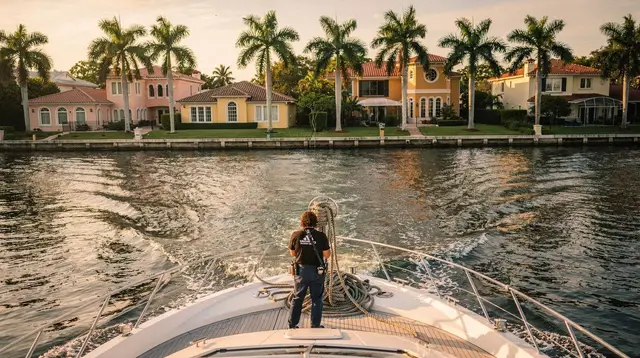
On the water, a few hours on a private yacht along Biscayne Bay at the end of the afternoon avoids the daytime heat and timing pressure of a big-group charter — it’s a slower, more private way to see the skyline from the water than a standard sightseeing cruise, and pairs naturally with the sunset cruise options if you want to compare formats before booking.
For a shorter, lower-cost version of the same idea, a 60-minute private flight with champagne fits into an evening without displacing dinner plans. Prices on all of these move with season and time slot — check the current rate on the booking page before committing, since dry-season sunset windows carry a premium over shoulder-season ones.
If a first visit means neither of you knows Miami’s geography well enough to self-navigate between neighbourhoods, a guided city tour covering Downtown, Brickell and the causeways on day one is a practical way to orient yourselves before choosing where to linger on later days — see where to stay in Miami for how that maps onto lodging choices.
Honest limits worth knowing before you book
A few things worth saying plainly rather than glossing over. Outdoor, golden-hour-dependent plans — flights, boat trips, rooftop dinners — are the first casualties of a bad-weather day, and South Florida’s afternoon storms are a near-daily feature of the wet season and an occasional one even in the dry season. Building in a flexible day, or at least a same-week rebooking option, matters more here than in a drier climate. During hurricane season (June 1-November 30, peaking August-October) it’s worth carrying travel insurance and choosing refundable rates where the cost difference is small, without assuming a storm is either likely or unlikely for any specific date — that’s simply not knowable more than about a week out.
It’s also worth resisting the instinct to pack every evening with a scheduled activity. The appeal of Coconut Grove’s shaded streets or an unstructured hour on Ocean Drive is partly that nothing is timed — a trip built entirely around booked slots (flight, dinner, cruise, repeat) can end up feeling as rushed as the loud version of Miami it was meant to replace. One or two anchor bookings per trip, with the rest left open, tends to hold up better than a full schedule.
Finally, price honesty: none of the figures above include Florida’s sales tax or the tipping norms that apply throughout South Florida, both of which are covered in more detail on the tipping and taxes guide rather than repeated here — worth a read before finalizing a budget, since they add a meaningful amount on top of any listed price.
Building it into a longer trip
None of the above needs to be the entire trip. A common pattern: two or three nights based in or near South Beach for the Art Deco evenings and easy beach access, a day given over to Coconut Grove and Coral Gables including Vizcaya, and either a Palm Beach overnight or a sunset flight or boat trip as the trip’s single splurge. For a fuller sense of how these pieces fit into a multi-day plan, the Art Deco and culture itinerary lays out a version built around exactly this pacing, and best sunset spots in Miami is worth a look if the golden-hour booking above isn’t in the budget and a free alternative will do. If the trip falls inside hurricane season, it’s also worth reading the hurricane season guide before locking in non-refundable bookings.
Questions couples ask about a romantic Miami trip
Is Miami Beach or Coral Gables better for a romantic stay?
Miami Beach gives you Ocean Drive, the Art Deco Historic District and walkable evenings, but it’s louder and busier. Coral Gables is quieter and greener, built around banyan-lined streets, and puts Vizcaya Museum and Gardens and the Venetian Pool within a short drive, at the cost of losing beach access on foot.
When is Miami least crowded for a couple’s trip?
Roughly May through October is the wet season and the quiet season at once: fewer visitors, lower hotel rates, but afternoon thunderstorms and hurricane-season risk from June 1 through November 30. If you want dry, sunny weather you’re choosing the busiest and most expensive months, November through April.
Is Palm Beach worth the drive from Miami for a couple?
It’s about 70 miles (113 km) and a little over an hour by car, or a comfortable Brightline ride from Miami through Fort Lauderdale to West Palm Beach. It suits one night away rather than a day trip, since the town itself — Worth Avenue, the Flagler Museum, quiet streets — rewards an unhurried pace rather than a quick pass-through.
Do sunset boat trips or flights need to be booked in advance?
Yes, especially around Miami’s dry-season peak (December through April) and any date near a holiday weekend. Sunset-timed slots on helicopter tours, small-plane flights and private yacht charters sell out first because there’s a fixed number of daily windows around golden hour.
Is the Art Deco Historic District only interesting at night?
No, but the character changes. By day it’s a walkable, photographable stretch of 1920s-1940s buildings along Ocean Drive; after dark the neon and facade lighting come on and the street slows into a strolling pace, which is when most couples say it earns the detour.
Does a Miami trip in hurricane season ruin romantic plans?
Not necessarily, but it changes the calculus. June through November carries real hurricane risk (peaking August to October), so outdoor-dependent plans like a sunset cruise or helicopter flight need flexible dates and travel insurance, and it’s honest to say some days will bring a storm that reshuffles the schedule rather than cancels the trip.
Trip planning guides for Miami and the Keys
Verified deep-linked GetYourGuide tours. Book through these links and we earn a small commission at no cost to you.
GetYourGuide does not provide a product photo for this activity — the image shows the meeting point, photographed by us.