South Beach art deco tours: walking the historic district
What are South Beach's Art Deco tours actually about?
They are walking tours through the Art Deco Historic District of Miami Beach, a stretch of hundreds of pastel buildings from the 1920s-1940s listed on the National Register of Historic Places. The focus is architecture and preservation history, mostly along Ocean Drive and Collins Avenue, and tours typically run 60 to 90 minutes on foot.
Where the Art Deco district actually is
Start with the geography, because it trips up a lot of first-time visitors. South Beach is a neighbourhood of Miami Beach, a city in its own right, sitting on a barrier island separated from mainland Miami by Biscayne Bay. Getting there from Downtown means crossing a causeway — the MacArthur, the Venetian or the Julia Tuttle — not walking through a district boundary. Calling South Beach “a part of Miami” is the single most common mix-up in this guide, and it matters here specifically because the architecture being discussed belongs to Miami Beach’s own municipal history, not Miami’s.
The Art Deco Historic District itself is a roughly one-square-mile zone, largely bounded by Ocean Drive, Collins Avenue, Washington Avenue and Lincoln Road, that was added to the National Register of Historic Places in 1979. It holds several hundred buildings constructed mostly between the 1920s and the 1940s: small hotels, apartment blocks and a handful of theatres, built in a regional variant of Art Deco sometimes called Tropical Deco or Miami Beach Deco, with add-ons like porthole windows, racing stripes, ziggurat rooflines and pastel paint schemes that came later, in the 1980s restoration wave, rather than from the original 1930s construction. This is a walking subject, not a boat or beach one — the whole point is slow movement along a few blocks of sidewalk, looking up at rooflines and signage rather than out at the water.
What a guided tour covers that a solo walk might miss
Anyone can walk Ocean Drive for free — it is a public street, and no ticket buys entry to a “district.” What a guide adds is context: reading a building’s facade well enough to date it, telling a restored original from a 1980s pastel repaint, and knowing which lobbies still show original terrazzo floors or Deco ironwork behind a hotel’s front desk. A one-hour walk with someone who does this daily turns rows of similar-looking three-storey hotels into a readable timeline of Miami Beach’s building boom, its decline through the 1960s-70s, and the 1980s preservation campaign that saved the district from demolition.
a guided walk through the historic district with a local guide covers the core stretch in about 60 to 90 minutes, pointing out details on Ocean Drive, Collins Avenue and the side streets that are easy to walk past without noticing — hotel typefaces, the pastel-versus-original-color question, and a few Miami Modern (MiMo) buildings from the 1950s that get mistaken for Deco. For a French-speaking group, a private walking tour conducted in French covers the same ground at a pace set for the group rather than a fixed public schedule.
Neither tour needs advance planning beyond picking a morning slot before the midday heat and the Ocean Drive lunch crowd build up. Prices for a small-group walk in this category typically sit in the $25-$45 per person range; a private version for a family or small group runs higher, generally $150-$300 for the group depending on length and language — check the current figure on the booking page before confirming, since rates move with season and group size.
Ocean Drive, without the myths
Ocean Drive is the district’s best-known street and its most crowded. The sidewalk cafes, the classic cars occasionally parked for photos, and the neon signage that lights up after dark are all real, but so is the fact that much of the strip now runs on restaurant commission and aggressive street-side touting rather than architecture appreciation — a guide who has a route memorized can move a group past the pressure points efficiently. The buildings worth stopping for include the Colony Hotel, the Waldorf Towers with its tiered nautical tower, and a run of small hotels whose stepped parapets and vertical fins define the classic Deco silhouette against the sky.
A practical note often left out of glossier write-ups: several of the most-photographed hotels are still working hotels with paying guests, so tours generally stay on the sidewalk and in public lobby areas rather than treating the buildings as museum exhibits. Respecting that is part of what keeps guided access working at all — a preservation district survives on goodwill from the businesses inside it as much as from a landmark designation.
Lincoln Road and the quieter side streets
A block or two back from Ocean Drive, Lincoln Road runs as a pedestrian mall lined with a mix of original 1930s-40s storefronts and later infill — some of it good, some of it not, which is itself part of what a knowledgeable guide will point out rather than gloss over. Española Way, a narrow Mediterranean-Revival-styled block that predates the Deco boom by a few years, gives useful contrast: not every historic-looking street in the neighbourhood is actually Deco, and telling the two apart is part of what separates a tourist snapshot from an accurate reading of the district.
These side streets are also where the crowd thins out. If Ocean Drive at midday feels more like a restaurant strip than a heritage walk, Lincoln Road, Española Way and the quieter residential blocks toward Flamingo Park give a better sense of the district as lived-in neighbourhood rather than backdrop.
Self-guided or with a guide: an honest comparison
| Self-guided walk | Guided walking tour | |
|---|---|---|
| Cost | Free | Roughly $25-$45 per person (small group); more for private/language-specific |
| Time | 60-90 min at an easy pace | Fixed 60-90 min slot |
| What you get | Streetscape and photos | Building dates, restoration history, access notes, context on preservation fight |
| Best for | Repeat visitors, budget trips, photographers wanting to linger | First visit, groups wanting the history explained, non-English speakers |
| Booking | None needed | A day or two ahead recommended for morning slots |
Neither option is wrong. A repeat visitor with a guidebook or a good map can absolutely do this alone; a first-time visitor who wants the “why” behind the pastel facades gets more out of a guide’s running commentary than out of a plaque.
Combining the walk with a water view
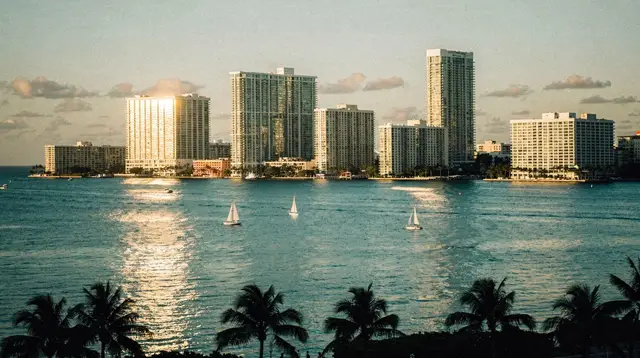
The district’s skyline reads differently from Biscayne Bay than it does from the sidewalk, and a few visitors like to pair the walking history with a look from the water on the same trip — not as a substitute for the walk, but as a different angle on the same coastline. A chartered boat trip along the Miami Beach coastline gives a wider view of the shoreline the Deco hotels sit on, useful context for how compact the historic strip actually is when seen from offshore.
For an aerial version of the same idea, a private flight over the Miami Beach coastline shows the district’s grid pattern and its position on the barrier island in a way no ground-level walk can — genuinely useful for understanding the causeway geography this guide opened with, though it is a different kind of activity and a different price bracket than a walking tour, generally several hundred dollars per person rather than tens of dollars.
What this isn’t
It’s worth being direct about scope. This page covers architecture and preservation history — building dates, styles, the 1980s fight to save the district from demolition. It does not cover ghost stories, shipwreck lore or narrative folklore; that kind of storytelling belongs to a different city and a different subject on the history and ghost tours of Key West, roughly 160 miles and three and a half to four hours’ drive south, built around Hemingway and 19th-century wreckers rather than 20th-century architecture. It also isn’t a water-sports or nature guide: for jet skis and open-water activity near Key Biscayne, a short causeway ride away, see the jet ski and water sports guide for that island instead, an entirely different kind of day out from a walking tour.
Practical planning
Ocean Drive and Lincoln Road are both flat and fully walkable, with no entry gates or ticket booths — the “district” is a preservation designation on the buildings, not a fenced attraction. Metrobus and the free Miami Beach trolley both reach South Beach from the mainland if driving and parking (expensive and often full on weekends) isn’t appealing. Sun protection matters more than most visitors expect on an open sidewalk walk at midday; an early start avoids both the heat and the worst of the crowds.
For background before or after the walk, the story of how Miami Beach’s Art Deco district was saved from demolition covers the 1970s-80s preservation campaign in more depth than a walking guide can fit in. Anyone curious about the district as one stop on a longer trip through Miami Beach’s history and museums can also check South Beach’s museums and attractions, or extend the day with a bike or Segway tour of South Beach that covers more ground than a walking loop can in the same time. Photographers chasing the pastel facades in good light may also want the broader list of Miami’s most photogenic spots for context on timing and crowds beyond this one neighbourhood.
For a comparison against Miami’s other major architecture-and-culture subject — contemporary murals rather than 1930s buildings — see how Wynwood became an open-air museum, a useful contrast piece precisely because it covers a different era, a different medium and a different part of the metro area (mainland Miami, not Miami Beach). Visitors building a full day or two around Miami Beach’s history and culture can also work from the art deco and culture itinerary for a longer sequence than a single walking tour covers, and general things to do in South Beach for the neighbourhood’s other options beyond architecture, from beach time to nightlife to food.
Frequently asked questions about South Beach’s Art Deco district
Is South Beach in Miami or Miami Beach?
South Beach is a neighbourhood of Miami Beach, a separate city on a barrier island across Biscayne Bay from Miami, reached by causeways such as the MacArthur and Julia Tuttle. It is never a district of Miami itself, even though both names get used loosely.
How long does an Art Deco walking tour take?
Most guided walking tours run 60 to 90 minutes and cover a compact loop of a few blocks around Ocean Drive, Collins Avenue and Española Way. A self-guided walk covering the same ground takes about the same time, longer with stops for photos or a coffee.
Do I need to book in advance?
Small-group and private walking tours benefit from booking a day or two ahead, especially for morning slots before the heat builds and before Ocean Drive gets crowded with restaurant touts. Self-guided walking needs no booking at all.
Is the Art Deco Historic District free to visit?
Walking the streets and looking at the buildings costs nothing; the district is a public streetscape, not a ticketed site. A guided tour is a paid service for context and access to details a visitor would otherwise miss, not an entry fee to the neighbourhood.
What’s the best time of day to see the buildings?
Early morning, roughly 8am to 10am, gives softer light on the pastel facades and fewer people on the sidewalk. Late afternoon works for the neon signage once it switches on, but Ocean Drive is busiest then with restaurant seating spilling onto the pavement.
Are the hotels on Ocean Drive still working hotels?
Most are. Many Art Deco buildings on Ocean Drive operate as small boutique hotels, so tours generally stay on the street and in public lobbies rather than guest floors, and a guide who knows a property can sometimes get a look at a preserved lobby.
Is this the same thing as Miami’s street art scene?
No. Wynwood’s street art is contemporary and covers Miami’s mainland Design District area with murals from the 2010s onward; the Art Deco Historic District is early-to-mid-20th-century building architecture in Miami Beach. They are different neighbourhoods, different eras and different subjects.
Art Deco and Miami history tours on GetYourGuide
Verified deep-linked GetYourGuide tours. Book through these links and we earn a small commission at no cost to you.
GetYourGuide does not provide a product photo for this activity — the image shows the meeting point, photographed by us.