A separate island, not a Miami Beach neighbourhood
Key Biscayne sits south-east of Downtown Miami, across Biscayne Bay, and it is reached by a single road: the Rickenbacker Causeway. That matters more than it sounds, because the island people usually picture when they say “Miami beach” — South Beach, with Ocean Drive and its nightlife — is a different island entirely, connected to the mainland by the MacArthur, Venetian or Julia Tuttle causeways further north. There is no bridge running directly between Key Biscayne and South Beach. If a day plan calls for both, budget a drive back through Downtown, not a quick hop across the water.
The confusion is common enough to cause real itinerary mistakes. Visitors staying in South Beach sometimes assume Key Biscayne is a short walk or a five-minute causeway ride away, the way North Beach or Key Biscayne’s own barrier-island neighbours might be. It isn’t. From South Beach, reaching Key Biscayne means crossing back to the mainland, driving south through Brickell, and then out over the Rickenbacker Causeway — typically 30 to 40 minutes depending on traffic, not the 10-minute crossing some expect.
What Key Biscayne offers instead of urban energy is space: a long park along the Atlantic side, a lighthouse at the island’s southern tip, and a beach that is markedly quieter than the sand in front of Ocean Drive. This page treats it as its own destination, not an annex of Miami Beach, and lays out what a half-day or full-day visit actually looks like.
Getting there: the Rickenbacker Causeway, not South Beach’s bridges
The only road onto Key Biscayne is the Rickenbacker Causeway, which starts near Brickell and Virginia Key before landing on the island. There’s a toll (a few dollars, cash-free, charged by transponder or by plate for rental cars), and the causeway itself is popular with cyclists on weekend mornings, so expect slower traffic then.
- By car from Downtown or Brickell: roughly 20-30 minutes without heavy traffic.
- By car from South Beach: 30-40 minutes, because the route goes back through the mainland first — there’s no direct link between the two islands.
- By bike: the causeway has a dedicated path and is a genuine cycling destination in its own right, not just a means to an end.
- By rideshare: straightforward and often simpler than driving and parking, especially on weekends when Crandon Park’s lots fill up.
There’s no Metrorail or Metromover service to Key Biscayne; a car, bike or rideshare is the practical option.
Crandon Park: the island’s main beach
Crandon Park runs along several miles of Atlantic-facing beach on the island’s north-east side. Compared with South Beach, the sand is wider, the water calmer, and the atmosphere closer to a family park than a scene. Facilities include picnic areas, restrooms, and a marina area used for water-sports rentals.
Crandon Park is also where most of the island’s on-water activity concentrates. Wing foiling and kitesurfing rentals operate from the park (an introductory wing foil session at Crandon Park or a kitesurfing rental and lesson at Crandon Park are the two most common ways in), and the shallow, protected water on the bay side makes it a reasonable spot for people trying either sport for the first time. For calmer, slower exploring, guided kayak and paddleboard routes work the mangrove edges of the park.
Parking has a per-vehicle fee, cash-free like the causeway toll. Arrive before mid-morning on weekends if a specific stretch of beach or a rental slot matters, since both the lots and the water-sports counters get busy once the day warms up.
Bill Baggs Cape Florida State Park and the lighthouse
At the island’s southern end, Bill Baggs Cape Florida State Park covers dense coastal hammock, a second beach, and the Cape Florida Lighthouse — the oldest standing structure in Miami-Dade County, dating to the 1820s (with a documented 1836 rebuild after damage during the Second Seminole War). The lighthouse and keeper’s cottage are open for tours on a limited schedule; check the park’s posted hours before planning around it, since access to the tower itself is not continuous through the day.
The park has its own entrance fee, separate from Crandon Park, and its own parking area. The beach here tends to be calmer again than Crandon’s, and the park’s southern point gives an open view across the entrance to Biscayne Bay, with Stiltsville’s stilt houses visible offshore on a clear day.
Between the two parks, a full day is realistic: morning at Crandon for water sports or the beach, then an afternoon walk through Bill Baggs and up the lighthouse. A half day covers one or the other comfortably, but not both without feeling rushed.
On the water around Key Biscayne
Key Biscayne’s sheltered bay side and the reef structure offshore support several small-boat and snorkeling operations that work specifically out of this part of Biscayne Bay, distinct from the bigger charter fleets based at Miami’s marinas downtown.
A paddleboard and snorkel tour over the fossilized reef near Key Biscayne is a low-key way to see the shallow reef structure without a full dive certification — expect a few hours, guided, with equipment included. For something faster, a Miami jet ski tour that departs from the Key Biscayne/Virginia Key side of the bay avoids the busier South Beach launch points and runs closer to the island’s own shoreline and the sandbars nearby.
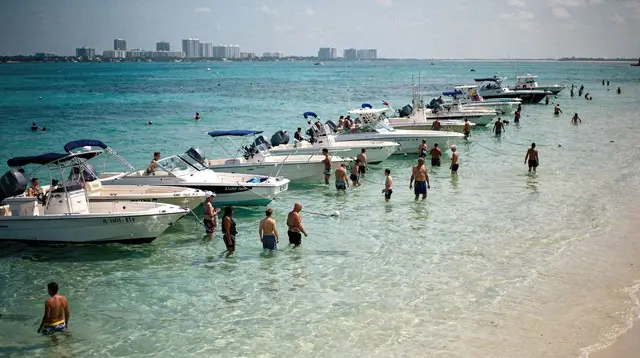
Sandbar days are a Miami Beach-area habit worth knowing about before booking: informal anchoring spots in Biscayne Bay where boats raft up in shallow water for an afternoon. They’re a different experience from a scheduled tour — more social, less structured — and worth reading up on separately if that’s the plan. Dolphins and manatees turn up in the calmer water around the island’s mangrove edges too; a dedicated dolphin and manatee watching trip covers where sightings are most likely across South Florida, not only here.
For a full rundown of what else fills a Key Biscayne day beyond the two parks — restaurants, the village centre, tennis and golf facilities — see the dedicated things to do in Key Biscayne guide, and for jet ski and water-sports options specific to the island’s launch points, Key Biscayne jet ski and water sports goes deeper than the overview above.
Nearby neighbourhoods and combining Key Biscayne with a wider trip
Key Biscayne works best as a half-day or full-day add-on to a Miami stay rather than a base of its own, since the island has few hotels compared with Downtown and Brickell or the beach hotels of South Beach. Most visitors day-trip in from wherever they’re staying and treat the island as one stop among several.
That makes it a natural fit for itineraries that already budget a Miami day for beach or nature time: a three days in Miami plan or a weekend in Miami itinerary can swap in a Key Biscayne morning in place of a second South Beach day for a quieter pace, and families following a Miami with kids plan tend to prefer Crandon Park’s calmer water and picnic space over the busier Ocean Drive strip. A longer family week in Miami itinerary can fit both without choosing.
For where to base a stay before or after the Key Biscayne day, where to stay in Miami covers the trade-offs between Downtown, Brickell, South Beach and the other main areas, and South Beach vs Brickell breaks down the two most common choices in more detail. From either base, the drive to the Rickenbacker Causeway is a manageable part of the day rather than a reason to change plans.
Practical planning: tolls, parking and timing
Beyond the causeway toll and the two parks’ separate entrance fees, a Key Biscayne day carries the same general costs as the rest of a Miami trip. Renting a car for the day is the most flexible way to reach the island and move between Crandon Park and Bill Baggs without waiting on a rideshare; renting a car in Miami covers tolls, parking norms and what to expect from rental counters more broadly. Restaurants and rental counters on the island add the standard Florida sales tax to posted prices, and tipping at any sit-down meal follows the same local norm as elsewhere in the region — Miami tipping, taxes and resort fees has the specifics.
Timing a visit around the calendar matters more here than in denser parts of the city, since the appeal is outdoor space. The dry season from November to April brings lower humidity and less afternoon rain, which is when both parks are most comfortable; best time to visit Miami lays out the broader seasonal trade-offs. The wetter months bring the Atlantic hurricane season, running June through November with its peak from August to October — an outdoor-heavy island day is one of the easier plans to reshuffle if a storm system is tracking through the region, and the Miami hurricane season guide explains what that actually means for a trip in practice.
Table: Key Biscayne vs South Beach at a glance
| Key Biscayne | South Beach | |
|---|---|---|
| Access from Downtown | Rickenbacker Causeway, ~20-30 min | Julia Tuttle or MacArthur Causeway, ~15-25 min |
| Direct link between them | None — route back through the mainland | — |
| Atmosphere | Park, beach, lighthouse; quiet | Ocean Drive, Art Deco district, nightlife |
| Typical visit length | Half day to full day | Full day to multi-day |
| Best for | Nature, cycling, calmer beach | Urban sightseeing, dining, nightlife |
| Parking | Paid, per park (Crandon and Bill Baggs separately) | Paid, limited, often costly |
Table: rough costs for a Key Biscayne day
| Item | Typical range |
|---|---|
| Causeway toll (car) | A few dollars each way |
| Crandon Park parking | Per-vehicle fee, cash-free |
| Bill Baggs entrance fee | Separate per-vehicle fee |
| Lighthouse tour | Free with park entry, limited schedule |
| Water-sports rental (wing foil or kite) | $$ for an introductory session |
| Snorkel or paddle tour | Check the current listing for the day’s rate |
Prices shift by season and operator; treat the ranges above as planning guides and confirm the current rate on the tour listing before booking.
Frequently asked questions about visiting Key Biscayne
Is Key Biscayne connected to South Beach by a bridge?
No. Key Biscayne is reached only by the Rickenbacker Causeway from Downtown Miami and Brickell. South Beach sits on a different barrier island, reached by the Julia Tuttle, Venetian or MacArthur causeways further north. Getting between the two means driving back through the mainland, typically 30-40 minutes.
Is Key Biscayne part of Miami Beach?
Not administratively and not geographically in the way people usually mean it. Key Biscayne is its own village with its own causeway access, separate from the barrier island that holds Miami Beach, South Beach and North Beach. It’s grouped with the Miami Beach region on this site because of its proximity and beach character, not because it shares a landmass or a bridge with South Beach.
How long does it take to get from Downtown Miami to Key Biscayne?
Around 20 to 30 minutes by car in normal traffic, over the Rickenbacker Causeway. Weekend mornings can be slower because the causeway is popular with cyclists and beachgoers heading the same way.
Should I visit Crandon Park or Bill Baggs Cape Florida State Park?
They’re different halves of the same island. Crandon Park, in the north, is the main beach and water-sports hub. Bill Baggs, at the southern tip, has a second beach, coastal forest, and the Cape Florida Lighthouse. A full day covers both comfortably; a half day means picking one.
Can I do Key Biscayne and South Beach in the same day?
It’s possible but tight, since there’s no direct bridge between them — plan on driving back through Downtown or Brickell, adding 30-40 minutes each way beyond whatever time you spend in each place. Most visitors are better served treating them as separate half-days or full days.
Is Key Biscayne good for families?
Yes. The beaches at both Crandon Park and Bill Baggs have calmer water than the open Atlantic side of South Beach, and Crandon Park in particular has shaded picnic areas and simpler logistics than the denser South Beach strip.
Do I need a car to visit Key Biscayne?
A car, bike or rideshare is necessary — there’s no Metrorail or Metromover service onto the island. Cycling the Rickenbacker Causeway is itself a popular activity, not just a way to arrive.
Is there an entrance fee for Key Biscayne’s parks?
Yes, both Crandon Park and Bill Baggs Cape Florida State Park charge separate per-vehicle parking or entrance fees, in addition to the causeway toll. Confirm current amounts before arriving, since park fees are adjusted from time to time.