Where to stay in Miami: choosing the right area
Where should I stay in Miami?
Match the area to the trip: Downtown and Brickell work for business and city stays with free Metromover access, South Beach works for beach and nightlife but a car there is a liability, Coconut Grove and Coral Gables work for a quieter, shaded stay, and Key Biscayne works for beach time without South Beach's density. Remember Miami Beach is a separate city from Miami, reached by causeway, so this is also a choice between two municipalities.
Pick the area by why you’re going, not by the name you’ve heard
Most guides describe what each Miami neighbourhood looks like. This one is about a narrower question: given the trip you’re actually taking, which area should you book. For a walk through what each neighbourhood contains — the museums, the streets, the food — see Miami neighbourhoods guide. For how many nights to plan, see How many days in Miami. Here, the focus is the decision itself: business or beach, walkable or car-dependent, lively or quiet, and which city — because that last one is a real distinction, not a figure of speech.
Miami Beach is a separate city from Miami. Miami sits on the mainland, on the western shore of Biscayne Bay. Miami Beach sits on a barrier island across the bay, connected to the mainland by causeways — the MacArthur, the Venetian, the Julia Tuttle. South Beach, the Art Deco Historic District, North Beach: all of that is Miami Beach, not “a Miami neighbourhood.” Choosing where to stay in this region is, first, a choice between two cities, and only second a choice of neighbourhood inside one of them.
Downtown and Brickell: for a city-first, business-first stay
Downtown and Brickell is the mainland’s business and high-rise core: office towers, Bayfront Park, Bayside Marketplace, the Perez Art Museum Miami and the Frost Museum of Science, plus the Port of Miami cruise terminals within reach. It suits travelers whose trip centers on meetings, museums, a short city stopover, or a cruise embarkation the night before.
The practical advantage is transit. The Metromover — a free, driverless elevated train — loops through Downtown, Brickell and the Omni district, so a hotel near any station puts restaurants, the waterfront and the arena within an easy, free ride. Combined with Metrorail, this is the one part of Miami where staying without a rental car is genuinely comfortable, not just possible. Details on the network: Getting around: Metromover, Metrorail and trolleys.
The trade-off: no beach. The nearest sand is across the bay in Miami Beach, typically a 15 to 25 minute drive or rideshare depending on traffic and which causeway you take, more at rush hour. Brickell and Downtown also empty out at night outside a few restaurant strips, so travelers who want beach mornings and nightlife should look at South Beach instead, not Brickell.
a private transfer from Miami International straight to your hotel removes one variable for a Downtown or Brickell stay, since both areas sit a reasonable, predictable ride from MIA.
South Beach: for beach and nightlife, without a car
South Beach, part of Miami Beach, is the area most first-time visitors picture: the public, free beach, Ocean Drive, Lincoln Road, the Art Deco Historic District’s pastel-facade buildings from the 1920s to 1940s, and the densest concentration of nightlife in the region. It suits travelers whose trip is built around beach days, people-watching and going out at night, and who don’t mind noise and crowds as the cost of that.
The clearest rule for this area: don’t bring a car, and don’t rent one for the stay. Parking is scarce, expensive, and many hotels charge a separate overnight parking fee that isn’t in the quoted room rate. South Beach is compact and walkable, and rideshare covers everything else, including trips back across the causeway to Downtown or the airport. A car only earns its cost if the same trip also includes the Everglades or the Florida Keys, in which case renting for those specific days — not the whole stay — usually works out cheaper. See Renting a car in Miami: tolls and parking.
Two costs to plan for that don’t show up on the room rate: Miami Beach sets its own resort tax on top of the county’s tourist tax, and some South Beach restaurants and hotels add a service charge automatically — worth checking the bill before adding a tip on top of it twice. More on this: Miami tipping, taxes and resort fees.
Coconut Grove and Coral Gables: quieter, shaded, and a real change of pace
Coconut Grove and Coral Gables sit south and west of Downtown, on the mainland, and suit travelers who want green space, shade and lower density more than nightlife or beach proximity. Coconut Grove has a village feel near the water with Vizcaya Museum and Gardens on its edge; Coral Gables has wide, tree-lined boulevards, Mediterranean Revival buildings, the Venetian Pool and the Biltmore Hotel. Both are calmer at night than South Beach and less commercial than Brickell.
The trade-off is distance from the beach and from the nightlife strip: expect a 20 to 35 minute drive or rideshare to South Beach depending on traffic. A car is more useful here than in South Beach, since the area is lower-density and spread out, though rideshare still covers most needs for a short stay. This combination — quiet streets, a garden museum, shade — makes the area a common choice for couples on a slower trip and for families with young kids who want a base that isn’t built around bars.
Key Biscayne: beach, without South Beach’s density
Key Biscayne is reached from Downtown by the Rickenbacker Causeway and sits on its own barrier island south of Miami Beach, with Crandon Park’s beach and the Bill Baggs Cape Florida State Park lighthouse at its southern tip. It suits travelers who want a beach stay without South Beach’s crowds, noise or nightlife — a genuinely different beach experience despite the short distance.
The cost of that quiet is fewer hotels, fewer restaurants within walking distance, and a car or rideshare being more necessary here than in South Beach’s walkable grid. It also sits further from the airport and from the rest of the city’s sights than either Brickell or South Beach, so it suits a stay built around relaxing rather than covering the whole region.
Side-by-side comparison
| Area | City | Best for | Getting around | Beach access |
|---|---|---|---|---|
| Downtown and Brickell | Miami | Business, museums, short city stopover | Free Metromover, Metrorail; car optional | 15–25 min to Miami Beach |
| South Beach | Miami Beach | Beach and nightlife | Walkable; no car needed, don’t rent one | On foot |
| Coconut Grove and Coral Gables | Miami | Quiet, shaded, family or slower trip | Car useful; some rideshare | 20–35 min to Miami Beach |
| Key Biscayne | Miami | Beach without South Beach’s density | Car or rideshare more necessary | On foot, quieter beaches |
Prices vary widely by season, view and property class, and change often enough that a fixed number here would be stale within months — check the current range on the property or on GetYourGuide and Viator listings for the neighbourhood’s paid attractions, and on the hotel’s own booking page for the room rate. Whatever nightly rate is quoted, add the county’s 7% sales tax and roughly 6% more in tourist tax, and check separately for a resort fee if the property is in Miami Beach.
Matching the area to the trip
- First trip, want to see a bit of everything: Downtown or Brickell as a base, with a day or two added in South Beach. The Metromover and Metrorail make Downtown workable without a car, and a short rideshare covers the rest. A city tour on the first day is a fast way to get oriented before deciding where to spend the remaining time.
- Beach and nightlife are the whole point: South Beach, walking distance to Ocean Drive and Lincoln Road, no car. Budget for the parking fee if you arrive by car and plan to leave it at the hotel.
- Business trip or cruise stopover: Brickell or Downtown, close to the port and the airport, with the free Metromover covering most evening plans.
- Family trip or slower pace: Coconut Grove or Coral Gables, both closer to Vizcaya Museum and Gardens and to green space than to a bar strip.
- Beach without the crowd: Key Biscayne, accepting fewer restaurants within walking distance in exchange for quieter sand.
- Trip that also includes the Keys or the Everglades: any mainland base (Downtown, Brickell, Coconut Grove, Coral Gables) works better than South Beach, since you’ll want the car for those days anyway and won’t be paying South Beach parking fees to store it overnight.
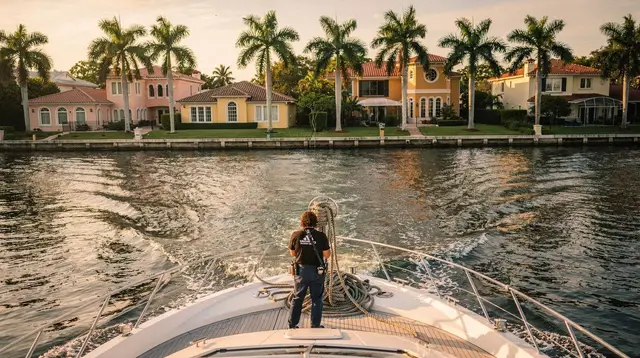
Whichever area you land on, a half-day city tour covering Downtown, Little Havana and Wynwood is a practical way to see the neighbourhoods you didn’t book before deciding whether a return trip should switch bases. For a first afternoon spent on the water instead, a private yacht rental out of Miami gives a view of both cities — mainland and barrier island — from the bay, which is often the fastest way to understand how they actually connect. Travelers arriving with limited time sometimes add a four-hour city tour on day one specifically to compare Downtown, Coral Gables and South Beach before booking a second stay.
Getting in and out, whichever area you choose
Most visitors arrive through Miami International (MIA), west of Downtown and linked by Metrorail’s Orange Line — convenient for a Downtown or Brickell stay, less so for South Beach or Key Biscayne, which need a taxi, rideshare or transfer. Fort Lauderdale-Hollywood (FLL), about 30 miles north, is often cheaper to fly into and works reasonably well for a South Beach stay too, since both airports are roughly comparable driving distance from the beach. See From Miami airport to Miami Beach for the practical routes.
Frequently asked questions about choosing where to stay in Miami
Is it better to stay in Miami or Miami Beach?
Neither is objectively better; they’re different trips. Miami (Downtown, Brickell, Coconut Grove, Coral Gables) is the mainland city, geared toward business, museums and quieter streets. Miami Beach (South Beach, North Beach) is a separate city on a barrier island, geared toward beach access and nightlife. Commuting between the two crosses a causeway and can take 20 to 40 minutes depending on traffic and which bridge you use.
Do I need a car if I stay in South Beach?
No, and it’s a liability. Parking in South Beach is scarce and expensive, many hotels charge a separate overnight parking fee on top of the room rate, and the area is compact enough to walk or use rideshare. A car becomes useful only if you’re also planning day trips to the Everglades or the Florida Keys.
Which area is best for a family with kids?
Coconut Grove, Coral Gables and Key Biscayne tend to work better than South Beach for families: quieter streets, more green space, and beaches without the density and nightlife noise of Ocean Drive. Downtown and Brickell can work for a short city-focused stay but have less green space and fewer family-oriented amenities within walking distance.
Is Brickell walkable, and is it close to the beach?
Brickell is walkable within itself — restaurants, bars and the free Metromover connect it to Downtown — but it is not on the beach. The nearest sand is across the bay in Miami Beach, roughly a 15 to 25 minute drive or rideshare depending on traffic and causeway.
Are hotel prices in Miami shown with tax included?
No. Miami-Dade County sales tax is 7%, and accommodation carries an additional tourist tax of roughly 6% in most of the county, with Miami Beach setting its own resort tax rate. Some Miami Beach properties also add a separate resort fee. The rate quoted at booking is rarely the final nightly cost.
Where should I stay if I want quiet, tree-lined streets?
Coconut Grove and Coral Gables are the two areas built around shade and lower density: Coconut Grove has a village feel near the bay, and Coral Gables has wide, tree-lined boulevards and Mediterranean Revival architecture. Both trade proximity to the beach for a slower pace.
Is Key Biscayne a good base for a beach-first trip?
Yes, for travelers who want beach access without South Beach’s crowds or nightlife. Key Biscayne is reached from Downtown by the Rickenbacker Causeway, has fewer hotels and a more residential feel, but also fewer restaurants and a car or rideshare is more useful there than in South Beach.
Trip planning guides for Miami and the Keys
Verified deep-linked GetYourGuide tours. Book through these links and we earn a small commission at no cost to you.
GetYourGuide does not provide a product photo for this activity — the image shows the meeting point, photographed by us.