The story of Miami Art Deco
Why South Beach looks the way it looks
The first time I walked down Ocean Drive at dusk, when the neon starts to compete with the last orange light over the Atlantic, I remember thinking the street looked like a stage set. Rows of low buildings, three or four storeys at most, painted in mint, peach, and dusty blue, their corners rounded off like the prow of a ship. That impression is not far off. Miami Beach in the 1920s to the 1940s was building for the eye as much as for shelter, and it shows.
I want to be precise about geography before anything else, because it is the single most common confusion I hear from visitors. This district is in Miami Beach, on the barrier island across Biscayne Bay from Miami, reached by causeways rather than by walking a few blocks from Downtown. South Beach is a neighbourhood of Miami Beach, not of Miami. I know it sounds like a technicality, but if you are trying to picture the map — or explain it to someone who is planning a trip — getting this wrong changes everything about how you get there and how long it takes. If the distinction is still fuzzy, our Miami neighbourhoods guide lays out how the mainland and the barrier island relate, and Miami Beach vs Fort Lauderdale is useful if you’re also weighing a stay further north.
A resort built fast, and built small
What strikes me most, once I started reading about the district instead of just photographing it, is how modest the ambitions were at street level. Miami Beach in this period was a young resort town chasing seasonal visitors, and small hotels, apartment buildings, and boarding houses went up quickly along a fairly compact grid near the beach. Land was subdivided in narrow lots, so buildings tended to be narrow too — which is part of why the district today feels dense and walkable rather than spread out like a suburb.
The style that took hold borrowed from what was fashionable elsewhere — streamlined forms, geometric ornament, a taste for symmetry — and adapted it to a beach climate. Builders leaned on features that made sense in the heat and the glare: deep shade over entrances, small windows that kept interiors cooler before air conditioning was standard, and a general lightness of material. None of it was meant to be permanent architecture in the grand sense. It was meant to look modern, cheerful, and a little glamorous to someone arriving off a train or a ship looking for a winter escape.
If you want the full architectural rundown rather than my impressions of it, our Miami Art Deco district guide covers the styles, the key blocks, and the practicalities of visiting, and a guided South Beach Art Deco tour is the fastest way to have someone point out details you would otherwise walk straight past.
The colour is newer than the buildings
Here is something that surprised me: the pastel palette people photograph today is not original to the 1920s and 1930s. Many of these buildings were originally a plainer white or cream. The saturated pinks, teals, and yellows came later, as part of a preservation-era push to make the district visually distinctive and to draw attention — and tourism — back to a neighbourhood that had fallen out of fashion and into disrepair by the middle of the twentieth century. I find that detail almost more interesting than the architecture itself. The look most people associate with old Miami Beach is really a layer added on top of it, decades after the buildings went up, by people trying to save them.
That distinction matters if you care about authenticity. What is genuinely from the period is the massing, the ornament, the rounded corners and porthole windows and stepped façades. What is a later addition is the paint job that makes it all so photogenic.
It is also, unsurprisingly, one of the most photographed streets in Florida — our roundup of the most Instagrammable places in Miami has South Beach’s pastel blocks near the top, and if you want elevated views rather than street level, Miami skyline viewpoints covers where to see the district and the bay together from higher up.
Decline, and the fight to keep it standing
By the 1970s, much of this stock of small hotels was tired, undervalued, and at real risk of being cleared for something bigger. This is where the story stops being purely architectural and becomes a story about preservation as an act of will. A determined group of residents and advocates argued that this cluster of modest buildings, taken together, was worth protecting as a district rather than saving one building at a time. That argument won, eventually, and the area was recognised and listed on the National Register of Historic Places — one of the reasons several hundred structures survived instead of being replaced by taller, blander towers.
I think about that whenever I hear someone dismiss the district as just a backdrop for photos. It survived because people fought a zoning and development battle for it, not because it was always obviously precious. Preservation here was contested, and it is worth remembering that the pastel streets people now consider essentially Miami Beach were, within living memory, considered disposable.
The district isn’t the only piece of protected heritage on this side of the bay, either. If historic preservation interests you beyond Art Deco, South Beach museums and attractions rounds up the other places telling that story, and further south, Vizcaya Museum and Gardens shows a very different, earlier chapter of South Florida’s built history on the Miami side of the bay.
Walking it versus seeing it from the water
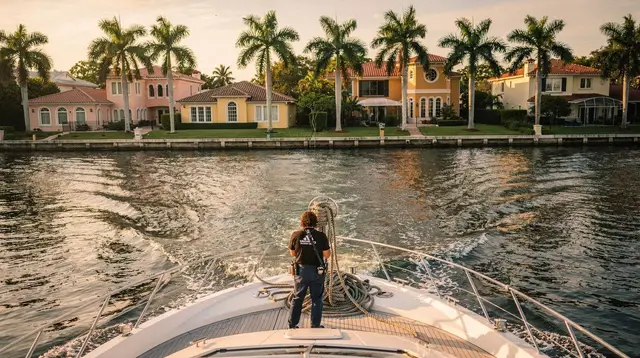
Most visitors experience the district on foot, along Ocean Drive and Collins Avenue, and that is the right way to see the ornament up close — the lettering on old hotel signs, the terrazzo floors visible through open lobbies, the stepped rooflines. But I would also say the skyline reads differently from Biscayne Bay, where you get the district in profile against the water rather than building by building. If that appeals to you, a vintage yacht cruise through Miami’s history gives a slower, wider view of how the built-up shoreline fits together, with some of the same period context you would get from a walking guide.
For a different angle on the same decades — the Prohibition-era money, gambling, and organised crime that also shaped South Beach’s early reputation — I have heard good things about a true crime cruise covering Miami’s darker history, which leans into the parts of the story that the pastel façades don’t advertise.
There are other ways to get out on the water near South Beach if a themed history cruise isn’t quite what you’re after. Our roundups of South Beach boat tours and cruises, Biscayne Bay cruises from Bayside, and, more broadly, Miami boat tours and yacht charters cover the options, and if you’d rather time it for the light, our Miami sunset cruises guide explains why the bay side of the skyline is worth catching at that hour.
Getting to South Beach, and getting around once you’re there
Because South Beach sits on the barrier island, not on the mainland, how you arrive changes the plan. Flying in, you’ll land at Miami International or, less often for this side of town, Fort Lauderdale-Hollywood; our guide on getting from Miami airport to Miami Beach covers the causeway crossing itself. Once you’re there, the Art Deco district is compact and walkable, but if you’re combining it with the mainland, getting around Miami by Metromover, Metrorail, and trolleys is worth reading, and anyone considering a rental should see renting a car in Miami: tolls and parking first, since parking in South Beach is tighter and pricier than most of the rest of the city.
What I’d actually tell a first-time visitor
Go slowly. The district rewards looking up and looking closely far more than it rewards checking off a list. Notice which colours feel too saturated to be original — they probably are. Notice how narrow most of the lots are, and how that narrowness shaped the buildings above them. And keep straight, for your own sake and for anyone you’re travelling with, that you are in Miami Beach, a separate city from Miami proper, connected by causeways rather than blocks.
If your trip includes both the beach side and the mainland, it helps to think of them as two different places with two different characters rather than one sprawling “Miami.” The Art Deco district is a Miami Beach story through and through — a resort’s quick, cheerful architecture, nearly lost, then deliberately and imperfectly saved.
If this is your first visit and you’re still shaping the itinerary, our guides on Miami for first-time visitors and how many days in Miami are a good starting point for fitting the Art Deco district in alongside everything else on both sides of the bay. And if you’re deciding where to base yourself, South Beach vs Brickell: where to stay lays out the trade-off between staying inside this history and staying across the water in the mainland’s business district.
Frequently asked questions about the Art Deco Historic District
Is the Art Deco Historic District in Miami or Miami Beach?
It is in Miami Beach, specifically in South Beach, on a barrier island separated from the city of Miami by Biscayne Bay and connected to it by causeways. It is not a Miami neighbourhood.
How old are the buildings in the district?
Most date from the 1920s through the 1940s, built quickly during Miami Beach’s early growth as a resort town. Many are modest, low-rise hotels and apartment buildings rather than grand landmarks.
Were the buildings always these bright pastel colours?
No. Many were originally plainer white or cream. The vivid pastel palette associated with the district today came later, as part of preservation and tourism efforts to make the area visually distinctive.
Why is the district protected today?
It was listed on the National Register of Historic Places after residents and preservation advocates argued, in the face of possible redevelopment, that the buildings should be protected as a cohesive district rather than demolished individually.
What’s the best way to see the architecture?
Walking Ocean Drive and Collins Avenue lets you see ornament and detail up close, ideally on a guided South Beach Art Deco tour. Seeing the shoreline from a boat on Biscayne Bay offers a wider, different perspective on how the district sits against the water — see our South Beach boat tours and cruises roundup for options.
Is the Art Deco district only about nightlife and hotels?
No — beyond the bars and boutique hotels, it is a recognised architectural and historic district. Its significance is about the built environment and its preservation, not just the restaurants and nightlife that also operate inside it. For the fuller architectural picture, see our Miami Art Deco district guide.
How do I get to the Art Deco district from the Miami mainland?
You’ll cross one of the causeways linking Miami to Miami Beach; see getting from Miami airport to Miami Beach for the route from the airport, or getting around Miami by Metromover, Metrorail, and trolleys if you’re coming from elsewhere on the mainland without a car.
tours.Culture
Verified deep-linked GetYourGuide tours. Book through these links and we earn a small commission at no cost to you.
GetYourGuide does not provide a product photo for this activity — the image shows the meeting point, photographed by us.