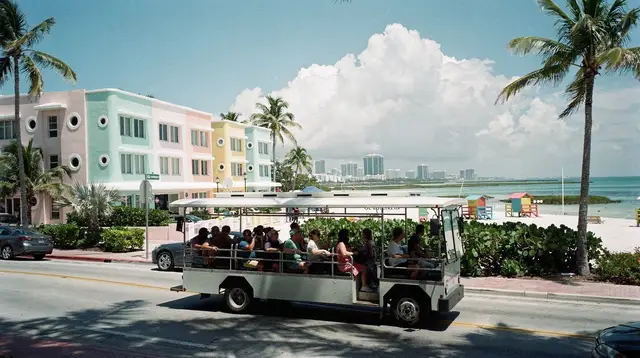
South Beach museums and attractions: the Art Deco Historic District on foot
What are the best museums and attractions to see in South Beach?
The main draw is the Art Deco Historic District itself — several hundred 1920s-1940s buildings along Ocean Drive and side streets, best understood on a walking tour or self-guided route. The Art Deco Welcome Center anchors most tours, and Lincoln Road adds pedestrian shopping and people-watching. Budget half a day on foot; this is a walking neighbourhood, not a museum campus.
Ocean Drive and the Art Deco Historic District
South Beach sits on a barrier island in Miami Beach, a separate city from Miami proper, reached across Biscayne Bay by causeways such as the MacArthur and the Venetian. That distinction matters here because the district covered in this guide — the Art Deco Historic District — is a Miami Beach landmark, not a Miami one, and confusing the two leads visitors to look for it on the wrong side of the bay.
The district runs roughly from 5th Street to 23rd Street, concentrated along Ocean Drive, Collins Avenue and Washington Avenue. It holds several hundred buildings dating mostly from the 1920s through the 1940s, built in the Art Deco and Miami Modern (MiMo) styles: low-rise hotels and apartment blocks with rounded corners, porthole windows, stepped rooflines, neon trim and pastel paint schemes. The district was added to the National Register of Historic Places in 1979, one of the earlier 20th-century districts to receive that status in the United States, and it remains one of the largest concentrations of Art Deco architecture anywhere.
This is a walking guide, not a boat guide. South Beach also has a strong water-based side — sunset cruises, jet ski rentals, boat charters — and that side is covered separately in South Beach boat tours and cruises. Here, the point is pedestrian: how to actually look at the buildings, what a guided walk adds over doing it alone, and where the walking route intersects with shopping, food and a couple of indoor breaks.
What’s actually here to see
Ocean Drive, between about 5th and 15th Streets, is the postcard stretch: hotel facades in mint, coral and cream, with lettering in period-accurate neon script. Many of these buildings are still operating hotels, so the interiors are viewable mainly from lobbies rather than as museum exhibits — the architecture itself is the attraction, best appreciated from the sidewalk or the beachfront boardwalk running parallel.
The Art Deco Welcome Center, on Ocean Drive near 10th Street, is the starting point for most organized walking tours and sells self-guided maps for people who’d rather explore alone. It’s small — a gift shop and information point rather than a full museum — but it’s the practical hub for anyone serious about understanding what they’re looking at rather than just photographing it.
Collins Avenue and Washington Avenue run parallel to Ocean Drive one and two blocks inland, with less foot traffic and, in places, better-preserved facades since they carry less restaurant signage and outdoor seating clutter. A walking route that loops out via Collins and back via Ocean covers more ground without repeating the same view twice.
Lincoln Road, a pedestrian-only shopping street a short walk north of the core district, is a different kind of attraction: open-air retail, cafes and public art, closed to cars since a 1960s redesign by architect Morris Lapidus. It’s not part of the historic district proper but sits close enough to combine into the same outing, and it’s the natural place to end a walk with a coffee or a meal.
North of Lincoln Road, toward Mid-Beach and Key Biscayne further south past Downtown, the architecture shifts to later MiMo styles and the crowds thin out — worth a look if the goal is architecture rather than a single iconic photo backdrop.
Guided walk versus self-guided
A guided walking tour, usually 60-90 minutes and priced roughly $25-$45 per person, adds historical context that isn’t visible just from looking: which buildings are original versus restored, why the pastel colour palette was chosen in the 1980s restoration effort rather than being original to the 1930s buildings, and which architects (Henry Hohauser, L. Murray Dixon among others) shaped the district’s look. For a first visit, this context is worth the fee — the buildings read very differently once you know what to look for.
Self-guided walking costs nothing beyond a map from the Welcome Center, and works well for a second visit or for anyone who prefers to set their own pace and stop for photos without a group schedule. Either way, plan for daylight: the architectural detail — cornices, tilework, lettering — is far easier to read in daytime than after dark, even though Ocean Drive’s neon comes into its own after sunset.
| Way to see the district | Typical length | Typical price | Best for |
|---|---|---|---|
| Self-guided walk (own map) | 1.5-2.5 hours | Free (map from Welcome Center) | Repeat visitors, flexible pace |
| Guided walking tour | 60-90 minutes | roughly $25-$45 pp | First-timers wanting context |
| Combined walk + Lincoln Road | Half a day | Free to $45 pp | Anyone pairing architecture with shopping or a meal |
Check the operator’s page for the day’s exact schedule and price — this guide keeps figures as ranges rather than a fixed number that goes stale.
Getting to South Beach and getting around the district
Visitors flying in land at either Miami International (MIA) or Fort Lauderdale-Hollywood (FLL), roughly 30 miles north; either way, the trip into South Beach crosses one of the causeways linking the mainland to the barrier island. Anyone deciding where to base a longer stay — South Beach itself versus a mainland neighbourhood like Brickell — has a dedicated comparison in South Beach vs Brickell: where to stay, which weighs walkability against nightlife noise and price.
A car is optional and, inside the historic district itself, often more trouble than it’s worth: Ocean Drive and the surrounding blocks have limited metered street parking and a scattering of paid lots, and weekend traffic on the strip crawls. Visitors who do rent for trips further afield — the Everglades, the Keys, Fort Lauderdale — will want the toll and parking notes in Renting a car in Miami: tolls and parking before picking up the keys. Remember that Florida, like the rest of the United States, drives on the right, which catches out visitors used to left-hand traffic when crossing Ocean Drive or Collins Avenue between sidewalks.
For the mainland side of a Miami trip — Downtown, Brickell, the airport transfer — the Metromover, Metrorail and trolley guide covers the public transit options that don’t reach South Beach itself but matter for anyone splitting a stay across both sides of the bay. Entry formalities are worth sorting before departure rather than at the airport: most Visa Waiver Program travellers need an approved ESTA, never a visa, applied for only through the official esta.cbp.dhs.gov site — the full rules sit in ESTA and entry rules for Miami.
Timing a South Beach day around the walk
Morning starts avoid both the midday heat and the thickest Ocean Drive foot traffic; the light is also better for photographing pastel facades without harsh shadow. A typical structure: Welcome Center and guided or self-guided walk in the morning, a break on Lincoln Road for lunch, then either the beach itself or a different neighbourhood activity in the afternoon, since two to three hours covers the architectural core.
Season matters more than time of day for comfort. The roughly November-to-April stretch brings drier, less humid weather and is the district’s busiest and priciest period, while the wetter, hotter months from around May through October see brief afternoon storms that pass quickly enough to still fit an Art Deco walk around them — the best time to visit Miami guide breaks down the trade-offs season by season. The Atlantic hurricane season runs officially from 1 June to 30 November, with the highest activity from August through October; it rarely disrupts a single day’s walking plans, but it’s worth checking forecasts a few days out during peak months, and the Miami hurricane season guide covers what that actually means for a short trip rather than a worst-case scenario.
South Beach is small enough to combine with other things to do in the same area — Things to do in South Beach rounds up the fuller list, including food and drink tours and bike and Segway tours that cover some of the same streets from a different angle.
For a change of pace after an afternoon on foot, a couple of indoor and adrenaline options sit within a short walk or ride of the district. An escape room is a straightforward way to fill an evening hour without needing a car — a heist-themed escape room in South Beach or a second South Beach escape room scenario both run for small groups and don’t compete with the walking itinerary for daylight hours.
For visitors who want an aerial view of the district’s grid and the barrier island’s shape against the bay, a private sightseeing flight over Miami gives a genuinely different perspective on how the causeways connect the island to the mainland — useful context for understanding why South Beach and Miami read as separate places even though they’re only a few miles apart by road. And for a faster-paced break on the water side of the neighbourhood, a jetcar ride paired with a boat tour is the kind of half-day add-on that works well after a slower architectural morning.
Not the same as Miami’s mainland museums
South Beach does not host the region’s large art and science museums. Those are on the mainland, in a different setting entirely: Perez Art Museum Miami and Frost Museum of Science sit in Downtown Brickell on the bay’s continental shore, and Vizcaya Museum and Gardens is further south in Coconut Grove. All three require crossing back over a causeway from the island — they’re not a same-afternoon add-on to an Art Deco walk, and treating them as one leads to an overloaded, rushed day. If the plan includes both, split them across two separate outings.
The Art Deco district story explains how a 1970s-80s preservation campaign, led in part by activist Barbara Baer Capitman, saved the district from planned demolition and set the pastel colour scheme now considered iconic — worth reading before a visit for anyone who wants the fuller history behind what’s now a protected National Register district.
Practical notes for the walk
Miami Beach is a city distinct from Miami, and this district sits entirely within it — worth remembering when giving a taxi or rideshare an address, since “Miami” alone won’t specify which side of the bay. Sun exposure is significant with little shade along Ocean Drive at midday; sunscreen and water matter even for a short walk. Tipping in restaurants along the strip follows the same 18-20% norm as the rest of South Florida, and menu prices, like everywhere in Miami-Dade County, are shown before the area’s sales tax is added.
Photography is unrestricted on public sidewalks, but several buildings are private hotels and residences — respectful distance from doorways and lobbies is expected, particularly during check-in hours. Weekends and evenings bring heavier foot and vehicle traffic on Ocean Drive itself; a weekday morning walk is the quietest option for anyone prioritising clear photos over atmosphere.
For a broader sense of what else the barrier island offers beyond the historic core — beaches, boat tours, and the wider Miami Beach photo spots — the destination overview for South Beach links out to the rest of the neighbourhood’s guides, and the Art Deco district guide goes deeper into individual buildings for anyone planning a dedicated architecture-focused day. Anyone building a longer stay around this and other Miami Beach neighbourhoods can start from the weekend in Miami itinerary for a day-by-day structure, or browse the history and Art Deco category for related walking and architecture options across the region. General planning notes — sales tax, entry rules, best time of year — sit in the travel tips hub.
Art Deco district and South Beach museums FAQ
Is South Beach part of Miami?
No. South Beach is a neighbourhood of Miami Beach, a separate city on a barrier island across Biscayne Bay from Miami, reached by causeways such as the MacArthur and Julia Tuttle. Locals and official sources keep the two apart, and this guide does too.
Do I need to pay to see the Art Deco Historic District?
No entry fee to walk the streets — the district is public and outdoors. Guided walking tours typically run in the $25-$45 range per person for 60-90 minutes; check the current schedule and price on the operator’s page for the day you plan to go.
How long does it take to see the Art Deco district properly?
Two to three hours on foot covers the core stretch of Ocean Drive, Collins Avenue and a loop past Lincoln Road, including stops for photos and a coffee. A guided tour usually condenses this to 60-90 minutes with commentary.
What is the difference between this guide and South Beach boat tours?
This page stays on land: architecture, walking routes and Lincoln Road. Boat tours, jet skis and sunset cruises from South Beach are a separate, water-based side of the neighbourhood covered in a different guide.
Is Ocean Drive worth visiting during the day, or only at night?
Both, for different reasons. Daytime shows the pastel facades and architectural detail clearly and without crowds; evening brings restaurant terraces, neon and nightlife, but the buildings themselves are easier to actually see in daylight.
Are there indoor museums in South Beach itself, or do I need to go to Downtown Miami?
South Beach has a handful of small design-focused spaces and the Art Deco Welcome Center, but the large museums — Perez Art Museum Miami, Frost Museum of Science, Vizcaya Museum and Gardens — are on the mainland in Downtown, Brickell or Coconut Grove, a separate trip across the bay.
What should I skip in South Beach if I only have one day?
Skip trying to combine a full Art Deco walk with a full beach day and a boat trip in the same afternoon — pick two. The district rewards slow walking, not a rushed pass-through between other plans.
Do I need a car to see the Art Deco Historic District?
No — this is one of the few Miami-area attractions that works entirely without a car. The district is compact and flat, built for walking, and most visitors staying anywhere in South Beach can reach Ocean Drive on foot. A car is more of a liability here: parking near Ocean Drive is limited and metered, and traffic on the strip itself moves slowly on weekends and evenings.
Museum tickets and Miami attraction passes
Verified deep-linked GetYourGuide tours. Book through these links and we earn a small commission at no cost to you.
GetYourGuide does not provide a product photo for this activity — the image shows the meeting point, photographed by us.